

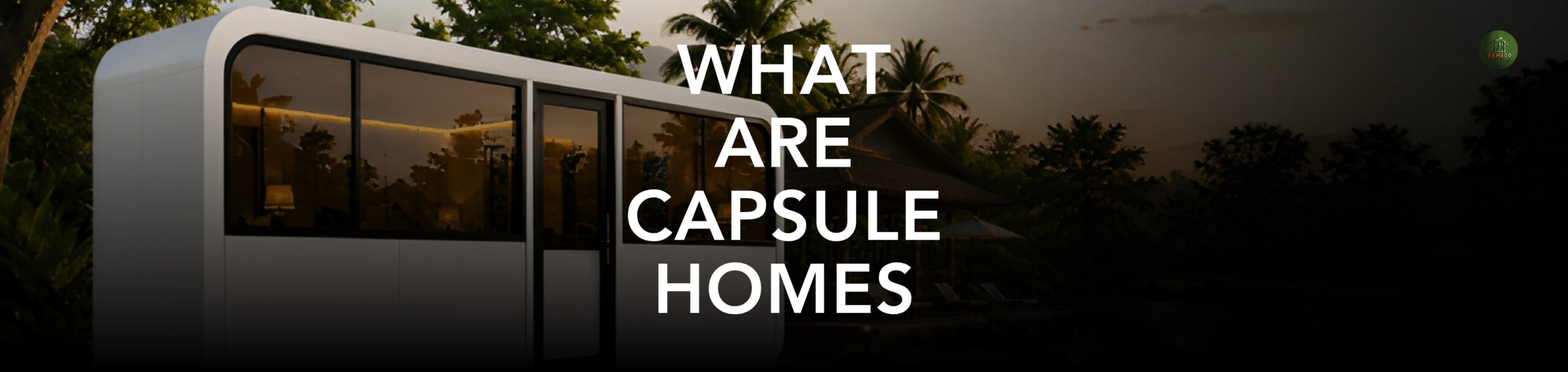
What Are Capsule Homes? A Complete Guide for Indian Buyers.
The way we build homes is changing. Rising construction costs, labour shortages, and the demand for faster project completion have encouraged the construction industry to look beyond traditional brick-and-mortar methods. One of the most innovative solutions to emerge from this shift is the capsule home.
Although capsule homes have become increasingly popular worldwide, they are still a relatively new concept in India. From luxury resorts and eco-tourism projects to farmhouses and site offices, these factory-built structures are changing the way buildings are designed, manufactured, and installed.
This guide explains what capsule homes are, how they work, and where they are best suited.
What Is a Capsule Home?
A capsule home is a factory-manufactured prefabricated building that is transported to the installation site as a nearly complete unit. Unlike conventional houses that are built entirely on-site, capsule homes are manufactured in a controlled factory environment where the structure, insulation, electrical wiring, plumbing, windows, doors, lighting, and interior finishes are completed before delivery.
Once transported to the site, the home is placed on a prepared foundation and connected to utilities such as electricity, water, and drainage. Installation typically takes only a fraction of the time required for conventional construction.
The term “capsule” refers to the compact, self-contained design rather than the size of the building. Modern capsule homes are available in different sizes and layouts, ranging from single-room studio units to larger models suitable for families or hospitality projects.
How Are Capsule Homes Built?
Unlike traditional construction, capsule homes follow a manufacturing process similar to industrial products.
The process generally includes:
- Structural steel frame fabrication
- Installation of insulated wall and roof panels
- Electrical wiring and lighting
- Plumbing and sanitary fittings
- Flooring and interior finishes
- Window and door installation
- Factory quality inspection
- Transportation to the project site
- Final installation and utility connections
Because most of the work is completed in a factory, weather delays, material wastage, and dependence on large on-site labour teams are significantly reduced.
What Materials Are Used?
Most premium capsule homes use lightweight but durable materials that are designed for transportation as well as long-term performance.
Common materials include:
- Galvanized steel structural frame
- High-performance insulated wall panels
- Aluminium doors and windows
- Double-glazed glass
- Waterproof roofing systems
- Engineered flooring
- Decorative interior wall panels
The choice of materials improves durability, thermal insulation, and ease of maintenance compared to conventional construction methods.
Where Are Capsule Homes Used?
Capsule homes are highly versatile and can be adapted for a wide range of applications.
Some common uses include:
- Eco-resorts
- Luxury resorts
- Farmhouses
- Homestays
- Glamping sites
- Holiday cabins
- Staff accommodation
- Site offices
- Educational campuses
- Healthcare facilities
- Tourism infrastructure
Their modern appearance and rapid installation make them particularly attractive for projects where construction speed and aesthetics are equally important.
Advantages of Capsule Homes
Several factors have contributed to the growing popularity of capsule homes.
Faster installation: Since manufacturing and site preparation happen simultaneously, projects can be completed much faster than conventional buildings.
Factory-controlled quality: Components are manufactured under controlled conditions, resulting in better consistency and fewer construction defects.
Energy efficiency: Insulated walls and roofs help reduce heat transfer, improving indoor comfort and lowering cooling requirements.
Minimal site disturbance: Less on-site construction means reduced dust, noise, and construction waste.
Modern design: Large glass panels, clean architectural lines, and efficient layouts create contemporary living spaces suitable for residential and commercial projects.
Are Capsule Homes Better Than Container Homes?
Capsule homes and container homes are often confused, but they are designed for different purposes.
| Capsule Homes | Container Homes |
| Designed specifically for living | Originally designed for cargo transport |
| Better insulation integration | Insulation usually added later |
| Flexible interior layouts | Limited by shipping container dimensions |
| Modern architectural appearance | Industrial appearance |
| Optimized for occupant comfort | Adapted from existing containers |
While both fall under prefabricated construction, capsule homes are purpose-built residential structures rather than converted shipping containers.
Are Capsule Homes Suitable for India?
India’s diverse climate requires buildings to perform in hot summers, heavy monsoons, coastal humidity, and, in some regions, seismic conditions.
Well-engineered capsule homes can be designed to suit these conditions through:
- Proper thermal insulation
- Corrosion-resistant structural materials
- Waterproof building envelopes
- High-quality glazing systems
- Site-specific foundation design
The suitability of a capsule home depends less on the concept itself and more on the engineering, materials, and manufacturing standards adopted by the manufacturer.
What Should Buyers Consider?
Before purchasing a capsule home, buyers should evaluate more than just the price.
Important considerations include:
- Structural engineering
- Insulation quality
- Wind and seismic resistance
- Foundation requirements
- Electrical and plumbing standards
- Manufacturer experience
- Warranty and after-sales support
- Transportation logistics
- Local building approvals
A well-designed capsule home should provide durability, comfort, and long-term reliability rather than simply offering quick installation.
Conclusion
Capsule homes represent the next evolution of prefabricated construction. By shifting most building activities from the construction site to the factory, they offer improved quality, faster project completion, and greater construction efficiency.
In India, capsule homes are finding applications in tourism, hospitality, residential developments, farmhouses, and institutional projects where speed, aesthetics, and predictable quality are important. As prefabricated construction continues to grow, capsule homes are expected to become an increasingly practical alternative to conventional building methods.
For buyers, the key is not simply choosing a modern-looking structure but selecting a manufacturer that prioritizes engineering, quality materials, and long-term performance.